Search This Blog

Wednesday, September 28, 2011

Fireworks!

Gold Price

Silver Price


Well, I expect you‘re wondering what on Earth’s been going on in the gold and silver markets. These charts look like the contrails from a Flash Gordon dogfight in the ionosphere. I’ll give you my take on what I think set the fireworks off, but before I do, I’d just like to explain one or two pieces of technical jargon, for those of you who live in the real world.
It’s important to understand what is meant by whether investors are “long” or “short” and whether or not they are trading on “margin”.
  • Long – this means you buy something and own it before you sell it – i.e. you plan to hold it for a “long” period of time. Investors who go “long” benefit if the price goes UP.
  • Short – means you sell something before you buy it. That means you may have to scramble to buy it “last minute” to honour your promise to deliver. You only want to own it for a “short” length of time, if at all. Investors who go “short” benefit if the price goes DOWN.
  • “Margin” is that fraction of the full asking price which an investor has to cough up to a broker in order to control an investment. If an investor asks his broker to buy a silver futures contract (a silver futures contract means 5,000 ounces of silver bullion to be delivered at a date in the future), the full price might be £20/oz x 5,000 ounces = £100,000. If the broker trusts him, he may be allowed to trade on margin and may only need to cough up 10% of the full price, so that’s £10,000. Now, say silver goes up by £4/oz, then he sells the contract for £24/oz x 5,000 ounces = £120,000. The broker bought the contract on the open market for £100,000 and collected £10,000 from the investor, so he’s still owed £90,000. The contract finally sold for £120,000, so after settling his outstanding balance with the broker, the investor is better off by £30,000. He trebled his money, when the price only rose by 20%. Of course, if the price goes down, losses are multiplied in just the same way.
The biggest, baddest player in the silver market is JP Morgan (or JPM). They have a huge “short” position in silver – over 330,000,000 ounces – which they inherited from Bear Stearns when it collapsed in early 2008, and which they have been rolling forward ever since (swapping earlier settlement contracts for later ones, indefinitely). This is more silver than all the mines in the whole world can produce in one year – in other words, it’s an artificial, synthetic position in silver futures, but it will cost JPM to close this position. From a “free market” point of view, this is like having a whale in a swimming pool – they can make a huge swell at any time, which profoundly affects all other players.
This extremely concentrated short position in silver, and the licence extended to them by the regulatory body, the Commodity Futures Trading Commission (CFTC), has given JPM immense power to manipulate the price of silver via the main US silver futures market, the COMEX (operated by the CME Group, a company which JPM actually OWNS, by the way…). They do this by writing new “short selling” contracts at will, which looks to the market like a sudden jump in the supply of silver for sale. This knocks prices down, at which point they swoop in and write “long” contracts at the new discounted price. This is called “covering the shorts” – in their case, it means that they can reduce their ponderous short position AND make a profit on each trade as well AND take delivery of real physical silver, laughing all the way to the bank.
Most inconveniently, JPM has just been sued (again) for manipulating the silver price, but this time the main perpetrators have been named:
JPM may be running out of time because the CFTC has been placed under intense public pressure to impose sensible “Position Limits” on futures traders, and could be voting on these measures as early as 4th October. A position limit is the maximum number of contracts which any one party can simultaneously hold. One of the wisest old birds in the silver market, Ted Butler, has led a 20 year campaign to see position limits in silver of 1,500 contracts (7.5 million ounces).
However, if you can persuade the policeman to look the other way, it’s amazing how quickly you can shift a troublesome load:
On Friday 16th September, the CFTC relaxed reporting disciplines for large traders who may want to carry out physical commodity swaps, for reasons which would be plausible if we lived in a world of unicorns and rainbows. On Wednesday 21st September, the price of silver started to drop, volume ramped up massively and for 24 hours there was wave after wave of sell orders.
Then on Friday afternoon, after normal trading hours, the CME announced that the contract margins had been increased on silver and gold: silver margins rose by 16% and gold by 21% - this is how much more extra money a trader would have to put down just to maintain their existing position.
On the Shanghai Metals Exchange around the same time, silver and gold margins also rose by similar amounts.
This is a staggering event, for the regulator to formally look the other way for the explicit convenience of the large traders only. Also, it is practically inconceivable that these major players had no advance warning of the margin hike, given that JPM effectively owns the COMEX and in view of the weight of historical evidence of apparent collusion between the CFTC, COMEX’s regulatory body, and JPM’s trading desk. These commentators put it very well:
The effect this had upon short margin players was disastrous. Immediately, the COMEX wanted more money from brokers to cover the margin hike, and the brokers, acutely sensitive to potential losses, either demanded substantially more collateral from their customers in turn to buffer against the loss, or they exercised their right to sell the underlying contract for its current value so as not to be out of pocket themselves. Selling reached a peak on Monday 26th, the deadline for coughing up the extra margin.
The driving force of the JPM short-selling machine, coupled with the margin hike, flushed out a torrent of speculative futures players, and the chain reaction accelerated to its final conclusion. Silver fell from about $40.50/oz on Wednesday 21st to $26 on the morning of Monday 26th. Yet barely a day later, the price had risen steeply to $32.
(STOP PRESS: As I was writing this, I received news that the CFTC "Position Limits" meeting will now be delayed until 18th October – perhaps JPM didn’t reach its targets by knocking a third off the silver price and needs a bit more time to cook the books. Will it be a case of "rinse and repeat" in October/November?)
So there you have it. The cops are in the crooks’ pockets and have been induced to look the other way while the crooks make a leisurely escape. Once JPM has minimised its silver short position and the new position limits are finally put in place, we can expect not only something like normal trading to resume and prices to rise, but also an increase in interest from new investors as they wander over to see what all the fuss was about, adding to the already hungry demand for physical silver.
While the crooks play these “paper” games to influence the price of gold and silver futures, in the world of “physical”, dealers are charging high premiums over and above these massaged prices. When prices plummeted over the weekend, many dealers closed their doors. They simply refused to sell a valuable asset at stupid prices; they will wait till the price bounces back again, which will not be long.  This price gap between “paper” and “physical” will grow until there is an acute shortage, especially in gold, at which point it may not be possible to exchange paper money for physical gold at any price.

Tuesday, September 27, 2011

Warning - Approaching Stall Speed...

BBC Speechless As "Trader" Tells Truth: "The Collapse Is Coming...And Goldman Rules The World"


BBC Releases Official Statement On Alessio "The Trader" Rastani: He Is Perfectly Legit And The Interview Was Not A Hoax

Read the Original Source at ZeroHedge
Statement on BBC News channel interview with trader Alessio Rastani

Date: 27.09.2011

The BBC have today issued the following statement regarding an interview with trader Alessio Rastani on the BBC News channel yesterday (Monday 26 September):

"We've carried out detailed investigations and can't find any evidence to suggest that the interview with Alessio Rastani was a hoax. He is an independent market trader and one of a range of voices we've had on air to talk about the recession."

BBC Press Office

Step Aside BBC "Trader": Head Of UniCredit Securities Predicts Imminent End Of The Eurozone And A Global Financial Apocalypse

Either the YesMen have infiltrated Italy's biggest, and most undercapitalied, bank, or the stress of constant, repeated lying and prevarication has finally gotten to the very people who know their livelihoods hang by a thread, and the second the great ponzi is unwound their jobs, careers, and entire way of life will be gone. Such as the head of UniCredit global securities Attila Szalay-Berzeviczy, and former Chairman of the Hungarian stock exchange, who has written an unbelievable oped in the Hungarian portal Index.hu which, frankly, make Alessio "BBC Trader" Rastani's provocative speech seem like a bedtime story. Only this time one can't scapegoat Szalay-Berzeviczy "naivete" on inexperience or the desire to gain public prominence. If someone knows the truth, it is the guy at the top of UniCredit, which we expect to promptly trade limit down once we hit print.
Among the stunning allegations (stunning in that an actual banker dares to tell the truth) are the following: "the euro is “practically dead” and Europe faces a financial earthquake from a Greek default"... “The euro is beyond rescue”... “The only remaining question is how many days the hopeless rearguard action of European governments and the European Central Bank can keep up Greece’s spirits.”...."A Greek default will trigger an immediate “magnitude 10” earthquake across Europe."..."Holders of Greek government bonds will have to write off their entire investment, the southern European nation will stop paying salaries and pensions and automated teller machines in the country will empty “within minutes.” In other words: welcome to the Apocalypse...

But wait, there's more. From Bloomberg:

The impact of a Greek default may “rapidly” spread across the continent, possibly prompting a run on the “weaker” banks of “weaker” countries, he said.


“The panic escalating this way may sweep across Europe in a self-fulfilling fashion, leading to the breakup of the euro area,” Szalay-Berzeviczy added.


Szalay-Berzeviczy has just arrived in Hungary from a trip abroad and can’t be reached until later today, a UniCredit official, who asked not to be identified because she isn’t authorized to speak to the press, said when Bloomberg called Szalay-Berzeviczy’s Budapest office to seek further comment.
And now, for our European readers (first) and everyone else (next), it is really time to panic.

Read more at ZeroHedge...

Peter Oborne 'Idiot' Comments Prompts EU Spokesman To Storm Off Newsnight


Wednesday, August 10, 2011

The Fish Don’t See The Water


"Banking was conceived in iniquity and was born in sin. The bankers own the earth. Take it away from them, but leave them the power to create money, and with the flick of a pen they will create enough money to buy it back again. However, take away from them the power to create money, and all the great fortunes like mine will disappear, and they OUGHT to disappear, for this would be a happier and better world to live in. But if you wish to remain the slaves of bankers and pay the cost of your own slavery, let them continue to create money."
- Sir Josiah Stamp, former Director of the Bank of England

"We are completely dependent on the commercial banks. Someone has to borrow every dollar we have in circulation, cash or credit. If the banks create ample synthetic money we are prosperous; if not, we starve. We are absolutely without a permanent money system.... It is the most important subject intelligent persons can investigate and reflect upon. It is so important that our present civilization may collapse unless it becomes widely understood and the defects remedied very soon."

- Robert H. Hamphill, Atlanta Federal Reserve Bank

“It is well enough that people of the nation do not understand our banking and monetary system, for if they did, I believe there would be a revolution before tomorrow morning.”
- Henry Ford

We are living in a financial environment which has been becoming more and more hostile towards ordinary people for a hundred years. The very medium of exchange – what we call “money” – is tainted at the source, and we are all contaminated by its use. The reason? The currency we use is borrowed into existence by governments from their Central Banks (at interest), which each control the supply of currency and credit (read: Debt) in their respective countries (read: National Debt) by creating it out of thin air. They have a monopoly on new reserves of this “thin air money”, so where does the extra interest come from to pay the National Debt? It comes from YOU and ME. It comes from the fruits of our work, as we strive to create value for other people, whose gratitude pays us. We create real value, which is then extracted as tribute by the money powers. Sadly, as not enough currency and credit exists to allow everyone to pay their part of the interest burden, some people go bust. At that point, their real and valuable collateral is taken from them in compensation, and the true nature of this subtle, elusive and fundamentally evil scam is exposed. Imaginary currency is used as the trap to steal real valuables from unwitting people.

Money used to be different. It used to be based on substance of real value, and was called asset-based money, rather than the debt-based currency and credit which masquerades as money today. The valuable thing was usually gold, and in most cases each new asset-based money system started off well enough, with good intentions and enough value tied up in the assets to allow all the paper currency in circulation to represent this value. The gold was normally stored in vaults, because it was so easily stolen if you carried it on you, and anyway, paper claims for the gold were normally just as good as the gold they represented – “as good as gold”. This is where the fabled words “I promise to pay the bearer on demand the sum of…” came from: once upon a time, you really could turn up to the gold store and exchange one of their valid paper receipts for an agreed amount of gold. Not any more...

Now if you’re not in business yourself, the next bit might be new to you and seem a bit abstract. Trust me: it is a real as going bust, and all healthy businesses spend a lot of their energy managing a thing called Working Capital. Working Capital is the liquid cash or credit you have at your disposal to buy things from suppliers and pay staff – it’s the “Readies”, if you like. Run out of Readies – you’ve gone bust. Today, most businesses run on an overdraft. If you go back more than 100 years ago, the Readies came from paper promises made by business people with real assets to back them. They were called Real Bills of Trading.

Real Bills were the perfect form of asset-backed, self-liquidating credit; they were also transferable and could function as real money in the economy, because they were backed by something which had real value. Real Bills were solid promises to pay (in gold) issued by a customer, with a term of 91 days (or 1 natural season, as much trade was literally “seasonal”); they could be passed from one person to another as an exchange of value. If an issuer of a Bill defaulted (“couldn’t pay his Bills”), they were made bankrupt and their reputation was ruined – there were no bailouts when the paper money was REALLY worth something. The invention of debt-based paper “Legal Tender” money in 1909, by the central banks of France and Germany, unleashed a process which rapidly destroyed the asset-based "Real Bill" as a vital medium of exchange, crowding them out of the marketplace with a flood of speculative bank paper. In common use, Real Bills could be “discounted” when transferred (i.e. you could sell them to the bank for, say 98% of face value in gold) so they could be used to pay raw materials suppliers and workers’ wages, well in advance of the original buyer’s final payment to the holder of his Real Bill.

This pool of “wages money” has been destroyed by paper legal tender money, and that is why there is permanent unemployment now – there never used to be before 1909. The banking system and their Legal Tender “debt” paper money has crowded out Real Bill “asset” money, at great social cost in terms of unemployment, business failure and reduced opportunity for ordinary people. However, for members of the Banking Club, it has been gravy all the way, and if a major bank should ever fail, their club membership nearly always entitles them to a bailout. After all, since modern money is worthless at source and it’s the banks who create it, it’s no cost to them to save one of their own.

And that's not all. Most of the funny money we play with nowadays was created by Clearing Banks, playing by Central Bank rules. If you're feeling strong, I'll tell you how it works in America (where most of the trouble comes from), via a fiendish, convoluted process dubbed as The Mandrake Mechanism and explained in the brilliant book The Creature from Jekyll Island. If you want to corroborate this information, refer to the (now out of print) article entitled "Modern Money Mechanics", originally published by the Federal Reserve Bank of Chicago and now available here.


The Mandrake Mechanism

GOVERNMENT DEBT

The federal government adds ink to a piece of paper, creates impressive designs around the edges, and calls it a bond or Treasury note. It is merely a promise to pay a specified sum at a specified interest on a specified date. As we shall see in the following steps, this debt eventually becomes the foundation for almost the entire nation’s money supply. In reality, the government has created cash, but it doesn’t yet look like cash. To convert these IOUs into paper bills and checkbook money is the function of The Federal Reserve System. To bring about that transformation, the bond is given to the Fed where it is then classified as a…

SECURITIES ASSET

An instrument of government debt is considered an asset because it is assumed the government will keep its promise to pay. This is based upon its ability to obtain whatever money it needs through taxation. Thus, the strength of this asset is the power to take back that which it gives. So the Federal Reserve now has an “asset” which can be used to offset a liability. It then creates this liability by adding ink to yet another piece of paper and exchanging that with the government in return for the asset. That second piece of paper is a…

FEDERAL RESERVE CHECK

There is no money in any account to cover this check. Anyone else doing that would be sent to prison. It is legal for the Fed, however, because Congress wants the money, and this is the easiest way to get it. (To raise taxes would be political suicide; to depend on the public to buy all the bonds would not be realistic, especially if interest rates are set artificially low; and to print very large quantities of currency would be obvious and controversial.) This way, the process is mysteriously wrapped up in the banking system. The end result, however, is the same as turning on government printing presses and simply manufacturing fiat money (money created by the order of government with nothing of tangible value backing it) to pay government expenses. Yet, in accounting terms, the books are said to be “balanced” because the liability of the money is offset by the “asset” of the IOU. The Federal Reserve check received by the government then is endorsed and sent back to one of the Federal Reserve banks where it now becomes a…

GOVERNMENT DEPOSIT

Once the Federal Reserve check has been deposited into the government’s account it is used to pay government expenses and, thus, is transformed into many…

GOVERNMENT CHECKS

These checks become the means by which the first wave of fiat money floods into the economy. Recipients now deposit them into their own bank accounts where they become…

COMMERCIAL BANK DEPOSITS

Commercial bank deposits immediately take on a split personality. On the one hand, they are liabilities to the bank because they are owed back to the depositors. But, as long as they remain in the bank, they also are considered as assets because they are on hand. Once again, the books are balanced: the assets offset the liabilities. But the process does not stop there. Through the magic of fractional-reserve banking, the deposits are made to serve an additional and more lucrative purpose. To accomplish this, the on-hand deposits now become reclassified in the books and called…

BANK RESERVES

Reserves for what? Are these for paying off depositors should they want to close out their accounts? No. That’s the lowly function they served when they were classified as mere assets. Now that they have been given the name of “reserves,” they become the magic wand to materialize even larger amounts of fiat money. This is where the real action is: at the level of the commercial banks. Here’s how it works. The banks are permitted by the Fed to hold as little as 10% of their deposits in “reserve.” That means, if they receive deposits of $1 million from the first wave of fiat money created by the Fed, they have $900,000 more than they are required to keep on hand ($1 million less 10% reserve). In bankers’ language, that $900,000 is called…

EXCESS RESERVES

The word “excess” is a tipoff that these so-called reserves have a special destiny. Now that they have been transmuted into an excess, they are considered as available for lending. And so in due course these excess reserves are converted into…

BANK LOANS

But wait a minute. How can this money be lent out when it is owned by the original depositors who are still free to write checks and spend it any time they wish? Isn’t that a double claim against the same money? The answer is that, when the new loans are made, they are not made with the same money at all. They are made with brand new money created out of thin air for that purpose. The nation’s money supply simply increases by ninety per cent of the bank’s deposits. Furthermore, this new money is far more interesting to the banks than the old. The old money, which they received from depositors, requires them to pay out interest or perform services for the privilege of using it. But with the new money, the banks collect interest instead, which is not too bad considering it cost them nothing to make. Nor is that the end of the process. When this second wave of fiat money moves into the economy, it comes right back into the banking system, just as the first wave did, in the form of…

MORE COMMERCIAL BANK DEPOSITS

The process now repeats but with slightly smaller numbers each time around. What was a “loan” on Friday comes back into the bank as a “deposit” on Monday. The deposit then is reclassified as a “reserve” and ninety per cent of that becomes an “excess” reserve which, once again, is available for a new “loan.” Thus, the $1 million of first wave fiat money gives birth to $900,000 in the second wave, and that gives birth to $810,000 in the third wave ($900,000 less 10% reserve). It takes about twenty-eight times through the revolving door of deposits becoming loans becoming deposits becoming more loans until the process plays itself out to the maximum effect, which is…

BANK FIAT MONEY = UP TO 9 TIMES NATIONAL DEBT

The amount of fiat money created by the banking cartel is approximately nine times the amount of the original government debt which made the entire process possible. When the original debt itself is added to that figure, we finally have:

TOTAL FIAT MONEY = UP TO 10 TIMES NATIONAL DEBT

The total amount of fiat money created by the Federal Reserve and the commercial banks together is approximately ten times the amount of the underlying government debt. To the degree that this newly created money floods into the economy in excess of goods and services, it causes the purchasing power of all money, both old and new, to decline. Prices go up because the relative value of the money has gone down. The result is the same as if that purchasing power had been taken from us in taxes. The reality of this process, therefore, is that it is a...

HIDDEN TAX = UP TO 10 TIMES THE NATIONAL DEBT

Without realizing it, Americans have paid over the years, in addition to their federal income taxes and excise taxes, a completely hidden tax equal to many times the national debt! And that still is not the end of the process. Since our money supply is purely an arbitrary entity with nothing behind it except debt, its quantity can go down as well as up. When people are going deeper into debt, the nation’s money supply expands and prices go up, but when they pay off their debts and refuse to renew, the money supply contracts and prices tumble. That is exactly what happens in times of economic or political uncertainty. This alternation between periods of expansion and contraction of the money supply is the underlying cause of…

BOOMS, BUSTS, AND DEPRESSIONS

Who benefits from all of this? Certainly not the average citizen. The only beneficiaries are the political scientists in Congress who enjoy the effect of unlimited revenue to perpetuate their power, and the monetary scientists within the banking cartel called the Federal Reserve System who have been able to harness the American people, without their knowing it, to the yoke of modem feudalism.

Wednesday, July 27, 2011

Update: Gold & Silver, Dollars & Euros


“The current talk in the mainstream financial media about gold being a bubble at $1,600 an ounce and of silver having already reached its top of its long-term peak at $50 an ounce is simply rubbish.

“A bubble is never defined by high prices, the perception of high prices or even a decade long rise in prices. What defines a bubble is a meteoric rise in price that is not supported by fundamental reasons.

“The fundamental reasons that have driven gold from $250 to $1,600 and silver from $4 to its current $39 – $40 range are even stronger today than they were at the beginning of this precious metals bull.

“Therefore, it is impossible for a bubble in gold and silver to exist at their current prices and at this current time.

“And for this reason, this is precisely why the global nuclear arms race has been replaced by a global physical gold race. Welcome to the new global war in precious metals.”


JS Kim – Original Source


It was not gold itself, but the Gold Standard, which Keynes described as a “barbarous relic”. The Gold Standard went through many formats over the decades, but essentially it required US dollars to be redeemable for a “permanent” fixed amount of gold. It was unworkable: everyone tried unsuccessfully to resist the tension caused by keeping the gold price fixed while the number of dollars increased unchecked, especially during the Vietnam War. In 1968, the French central bank forced the issue by demanding US gold for their petro-dollars, and America refused. A couple of years later, Nixon formally severed the link between the dollar and gold.

World Bank President Robert Zoellick said in December 2010 that the world should change its relationship with money so that gold becomes the reference for value. In future, a fixed gold price would not work as this reference for valuing currency and credit in a new system. A floating price would, but it would have to be much higher than today’s price to represent enough value to support these new currencies, in whatever form they take. Some call this concept “Freegold”.

The current dollar system is falling apart, right in front of our eyes, right now. Although it is impossible to be accurate about the timing of how this crisis will unfold, my personal view is that the following key events are now inevitable:
  • The ruling American powers will increasingly allow the United States to be seen as a country which will default on its debteven by the Federal Reserve Bank. However, this is manipulation of public perception; they have no intention of explicitly defaulting, as this would end their game. They will raise the debt ceiling and continue to debase the dollar, so that their unpayable dollar-denominated debt becomes increasingly worthless.
  • Because of this debasement, the US dollar will soon lose its status as the world’s reserve currency (this is happening already, as central banks are slowing down or ceasing their accumulation of new dollar-denominated assets).
  • Non-US owners of US dollar-based assets will want to exchange them for anything else which keeps its value more reliably.
  • There are more dollars outside the US than there are inside it. When these foreign dollars start to come home, the value of the dollar in the USA will plummet and the rate at which dollars change hands will accelerate. This is called hyperinflation.
  • Sovereign debt in the Southern European states will collapse and these countries will revert to their old currencies, devalued by up to 30%. The “Nordic” Euro as a currency will survive without them, for two reasons: firstly, it is not a national currency and secondly, it is supported at the European Central Bank by substantial gold exchange reserves: over 550 tonnes of gold bullion, plus other gold receivables, which the ECB revalues every 3 months using the actual market price of gold (gold and receivables valued at over €363bn on 30th June 2011). The Euro was deliberately designed from the outset to withstand the stresses that will destroy unbacked national currencies like the US dollar.
  • All non-US central banks have been steadily and quietly buying gold for at least a year, some for much longer.
  • There will come a crisis point, which will be seen in retrospect as the “Great Reset”. The dollar, and many other national currencies, will be abandoned. At this point, gold will be artificially and collectively revalued upwards ONCE so that its new value is sufficient to back the new currencies. This gold revaluation will be very substantial, of the order of 5-10 times or more of its current value, and will be permanent.
Between now and the Great Reset, the price of silver will often rise faster than that of gold and will also be more volatile, as increasing numbers of people realise their national currency is an unsafe long-term store of value and will buy various precious metals instead. However, since central banks and very wealthy individuals hold gold in great quantity, but not silver, silver will not be used as the basis for a new money system, and will not be artificially revalued as gold eventually will.

So we might expect:
  • Prior to the Great Reset, silver to often outperform gold as an investment.
  • A single, huge and permanent increase in the value of gold.
  • A high, floating price for gold thereafter.
For these reasons, I would recommend you move anything you consider to be investment money into vaulted gold bullion. At times when silver looks set to rise faster than gold, sell maybe 30-70% of your gold (depending on how adventurous you feel) and buy silver bullion. When silver peaks, sell the silver and buy gold again. In this way, you will end up with more gold than your cash alone would have bought. You can do this very easily at BullionVault.

Holding a growing quantity of vaulted gold bullion indefinitely will give you great financial protection and flexibility. At any time, part of your bullion can be turned back into cash for immediate use; inflation will have no damaging effect on your store of value because gold prices are rising faster than inflation, and in the longer term a global gold price revaluation will give you an almost unimaginable return on your investment.

Tuesday, June 28, 2011

How QE3 will save the World

July will be a rotten month for bonds and precious metals, so that everyone gets the message that we need more QE. Once that is agreed, precious metals will rally strongly. In 2009, after the summer doldrums where the gold price fell over June/July, the price rose 15.7% between 1st August and 31st December. Exactly the same pattern occurred in 2010, with an Aug-Dec rise of 15.9%

The silver fraud is approaching the end game. The crooked banks most likely to be the subjects of an Interpol investigation would be the US and Swiss banks JPMorgan Chase, Union Bank of Switzerland (UBS), and Credit Suisse.

The Powers That Be are looking for a calamity situation, where the US Govt will clamour for QE3 (or Operation Twist 2 as it is becoming known) to save them. Likely financial events in July 2011 include stock market drops from June highs, a significant/scary drop in bullion prices, Greek bond meltdown contagion spreading to Europe and possibly USA. Non-financial events include flooding of nuclear power stations, freak tornadoes, earthquakes in active zones and possibly the limited imposition of martial law (for the protection of citizens). Phew! If these things all happened around the same time – what a dreadful coincidence; but surely, that would be disastrous enough to do the trick… however,America’s grain harvest will already be dire, as an enormous swathe of the mid-West is underwater. Food prices will increase to alarming levels, so this could already be bad enough.

Inflation of goods prices will come home to roost in the USA, after a long period when overseas suppliers were content to take US dollars and exchange them for their own currencies, so as to keep their exchange rates constant. They are now revaluing their own currencies so their goods will cost more in US dollars.
Following the legitimisation of the Muslim Brotherhood as political party in Egypt, control of the country will be transferred into their hands in short shrift. The same will soon happen in Libya, Yemen, Oman, Syria and Jordan. US citizens will be able to watch this choreographed political theatre with a sense of detachment until the final domino topples – Saudi Arabia, their main source of oil. Oil prices would probably double; US gasoline would cost $8-10/gallon.

Rumour will start to emerge, very tentatively at first, that there is a small possibility that the US Govt may default on their National Debt. The biggest single holder of US debt is the Federal Reserve Bank, who will act heartily displeased, although this is all going according to plan. The Fed will exercise its right to flex its Balance Sheet, which includes the ultimate rights of ownership over one million homes acquired via their mortgages when the Fed swapped new credit for MBSs held by poorly capitalised banks between 2008 and today. The Fed will become the biggest landlord in the world and would be able to put a large number of US citizens out on the streets, from where it is one short step into a FEMA “emergency” holding camp.

Sunday, June 12, 2011

What Can’t Get Fixed – Won’t

The US Powers That Be cannot fix their Dollar system – but then, they are not trying to. Americans get very upset about how “stupid” their government and central bank are, naively assuming that the main objective of these bodies is to fix the system for the benefit of the people. However, turn this on its head and assume instead that the banking Elite are actually planning a controlled crash of the dollar system to benefit themselves: then all their activities suddenly make horrible sense.

Imagine for a moment that, instead of trying to lead America to a new era of prosperity, Obama is the front man for a very well organised campaign to destroy free market capitalism in America and replace it with a banker-engineered form of authoritative socialism (this has NOTHING to do with liberating the proletariat). It would be achieved by means of a series of orchestrated crises, which would lead to the collapse of the state welfare system through an overwhelming burden of new claims upon it by desperate people. This subversive approach was first outlined by two socialist academics in 1966 (click link for Google seach on Cloward-Piven Strategy). It would certainly explain why the USA is utterly failing to address its massive government overspend - there is no intention to.

The purpose of Quantitative Easing (QE) is NOT to monetise the National Debt (i.e.create new dollars and exchange them for government debt). The main purpose is to fend off unscheduled dollar collapse by keeping interest rates low, so that the interest payments due from the US Govt on their bonds can remain as low as possible. In shock news yesterday, it turns out that practically NONE of the $600bn issued under the 7-month QE2 programme which started in November 2010 has gone to help recapitalise US banks - almost every dollar has been spent in propping up European Banks instead! (see Zero Hedge article). But remind yourself that the Fed is a private bank, with very wealthy European shareholders... and, once again, it all makes sense.

And while that continues, the Federal Reserve actually wants an “orderly” rise in the value of gold – say 10% a year – so that the dollar’s value is eroded over time and the US Govt debt commitment is diminished in real terms.

For political reasons, the Fed does not wish to appear weak, so they will not launch QE3 without being forced to by an agitated Congress. Their QE2 campaign officially ends on June 30th, so there will be no more official funds made available to their favoured (apparently non-US) primary dealers. This drying up of cash, coupled with weak second-quarter results for all big corporations which rely upon Japan, will very likely cause an immediate slump in US share prices. If this should coincide with some other non-financial crisis, such as more extreme weather, a nuclear emergency, seismic activity or aggressive foreign overtures, then most Americans will beg for “stimulus” to be restored.

The biggest problem will be if events should accelerate beyond the control of the central planners and the Fed's “orderly” process is derailed from its preferred path. Japan’s recent crisis and their sudden, acute need to sell their US Treasuries (they hold over $800bn worth) to pay for the tsunami recovery work, could well trigger this. Expect an unannounced initiative from the G8 countries to print money and buy US Treasures in a coordinated way, such that no one country drives the dollar over the cliff. There will be no publicity - but the evidence will be there on the accounts of central banks for those who care to look.

This is political dynamite because it's so big. It will dwarf the already enormous scale of what the Fed has done to date, and practically guarantees hyperinflation in most Western countries. You might want to call this Global QE, because despite the fact that this clandestine manoeuvre will not be given a public name, that is effectively what it will be.

Thursday, May 19, 2011

If Governments are supposed to be in charge...


  1. Why is it that our so-called sovereign governments borrow their countries' money from privately-owned Central Banks (which charge interest) when they could each create all the interest-free money they need?
  2. Where does the extra money come from which they need to pay down the interest as well? If that has to be borrowed too, then their debt just gets bigger... and bigger...
  3. How can a money system, which can only function with perpetually accelerating growth, be used to build a sustainable economy? Isn’t it logical that perpetually accelerating growth and sustainability are incompatible?
  4. What is it about our current system which makes it totally dependent upon perpetual growth? What needs to be changed to allow the creation of a sustainable economy?

Paul Grignon's Money as Debt - Mini Video Tutorials

VIDEOS: Paul Grignon's "Money as Debt" mini series on Youtube

Sunday, October 31, 2010

When Push comes to Shove

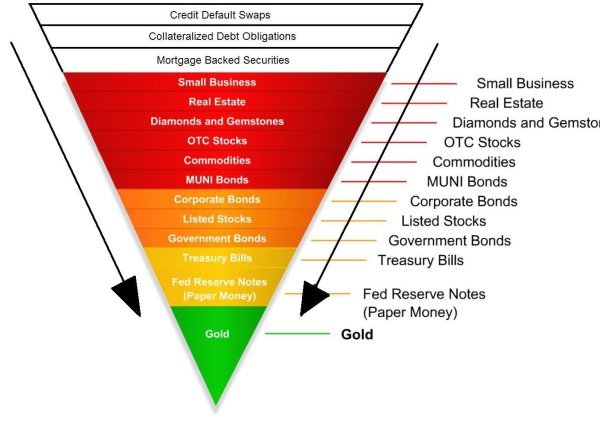
Most people don't realise that the value of their "paper" wealth (i.e. dollars, pounds, shares, bonds, derivatives, ETFs, etc) is based only on hope and promises. The investments themselves have no material value - they are just paper with ink on them. You hope someone else will deliver some greater future value to you when you want it, probably in cash.

There is a heirarchy of investments, a ladder from the more solid to the more speculative: as you go up the ladder, the financial strength of each rung is based on the perceived strength of the rung below.

Exter's Pyramid (click image to enlarge)

When the most complex and most widespread investment class fails (i.e. derivatives - the blue slice at the top of the picture), all these battered investors scramble down the ladder to lodge any surviving wealth "safely" on lower rungs (e.g the red or the orange slices), which massively increases the demand upon these "safer", less complex investments and their prices rise sharply. Of course, if the supply of these lower level products is overwhelmed by this desperate rush of capital, and greedy brokers take liberties along the way, these investments may well collapse in their turn and so the capital cascades down to flood the levels even further below.

The Tower of Jenga - What goes up must come down (click image to enlarge)

Can you see that the whole inverted pyramid of value in the so-called sophisticated world of investment is a tottering Tower of Jenga, supported ultimately by the presence of gold? Gold has always been the foundation for money, and people have always attempted to expand it, inventing fancy variations and alternatives to it and then abusing and inflating these mutant creations into oblivion along the way. Oh yes - this is not the first time a currency has been destroyed by debasement.

If a massive torrent of displaced wealth is released from the higher levels, where do you think it is going to eventually settle, and what effect do you think this will have on the value of gold? Physical gold carries its own material value: you don't have to trust someone else to make good on your gold, the gold IS the value, so gold is where the buck stops.

I listen to the fag-end "currency reports" on news broadcasts: "The Dollar is up against the Euro, the Euro is down against the Pound" and it conjures up the image of a group of formation sky divers plummeting to earth, holding hands, each one drifting slightly up or down relative to the other, as the ground comes screaming up towards them. No-one is wearing a parachute.

This is why I have encouraged my family and friends to put their savings and investments into physical gold bullion - in my mind, it's not a hedge against price inflation or a punt on a promising commodity with bubble potential: it's protection for their capital against the complete ruin of the existing money system.

If your investments suddenly look flaky, then ask yourself - what would I accept instead, in full settlement, so as to be sure of getting the value I was hoping for? And if, for any reason, the international money system breaks down and is replaced by one or more alternative systems, what do you think will happen to all the existing wealth which is still defined in the old money? And on what basis do you think "New Money" value will be defined from the beginning? Dollars? Pounds?

Wake up and buy gold, my friend - then you can sleep soundly at nights.

Thursday, October 14, 2010

Gold and Silver: What IS Going On?

Mike Maloney runs www.GoldSilver.com and has been trading in precious metals since 2003. He has made an excellent movie about how Gold and Silver function as money, and what always happens to their price when paper "fiat" money gets created in greater and greater quantities. This movie is being published in bite-sized chunks and you can watch it below.

If you are nervous, excited or baffled by what is happening in the international financial markets right now, then this is for you. Dive in!

1 - Cash Is Trash


2 - Gold Accounts For Expanding Fiat Currency


3 - $15,000 Gold?? Here's Why...


4 - Silver to Initially Out-Perform Gold


5 - Global Rush to Buy Gold and Silver


6 - Scandal! Gold and Silver Price Manipulation Exposed


7 - Gold Reserves: Illegal Accounting by US Government


8 - Exposed: Gold and Silver Price Manipulation


9 - Gold and Silver -v- Real Estate


10 - Why Gold and Silver? Investment Advisors

Tuesday, July 20, 2010

What Colour is Your Parachute?


We have grown up, conditioned to believe that Currency = Money = Wealth and to accept the idea that our financial worth is best measured in terms of our national currency units: Pounds Sterling, Dollars and so on. But currency, money and wealth are not the same thing. Let me be pedantic for a moment and offer some working definitions:

Currency – the unit of accounting for transactions (usually paper, or fiat). It flows, like the current of a river, and represents, or symbolises, the movement of value from one place to another.
Money – items of actual value, very widely accepted as a medium of exchange in trading. For most of history, this has meant gold and silver coins or bullion which has inherent value. Only in the last century or two has currency largely taken over this role (at least, while a country’s currency system operates normally).
Wealth – accumulated store of money (not currency) - real assets of long-term value. Usually traded very infrequently.

What is fiat paper money? Fiat is Latin for “let it be done” and is used to describe currency which has been issued “by decree”. Fiat currency is first created by a central bank and then issued to a government as a National Debt which is nominally repayable, with interest. The government then distributes the currency to its citizens via the banking system, and decrees that it is legal tender: it can be used to pay government taxes, and must always be accepted in settlement of trade debts. Governments normally create some form of taxation system, ostensibly to repay the interest on the National Debt.

But this currency is not money; it does get used in place of money, and if all goes well, it may even fulfil many of the functions of money better than money itself. Money has inherent value, whereas currency does not. Currency represents a unit of exchange, but is not the value itself; money has value itself. We are not used to thinking like this.

The most direct route is to riches is to use currency to acquire real wealth assets, then to hold them. However, the confusion between currency and wealth arises because all currency it is founded on DEBT. On the simplest level, personal debt is the opposite of personal wealth: Debt is an obligation to give back value to another party, whereas Wealth is real assets which flow towards you and belong to you. Paper currency simply cannot be the basis for storing Wealth as it is made of the wrong stuff, although it is often used as a snapshot measure of the current value of somebody’s Wealth.

What causes Inflation?

But governments can issue more currency at any time, in paper and electronic form. When they do, they get to spend it at face value before anyone else, but then it flows into the normal money system, increasing the number of banknotes and bank deposits in circulation without increasing the amount of real, valuable assets that exist. This effectively dilutes the value of all the existing “money” (currency), as more notes are chasing the same amount of goods. This is the definition of inflation – an increase in the “money” (currency) supply. Because prices don’t rise when the government first spends their brand new currency, often taking 6-18 months to manifest at the corner shop, banks can then point to the symptoms of inflation (rising prices) and cleverly deflect the blame for the cause of it onto grasping, selfish suppliers whose greed hurts everybody.

Bullion Markets

The markets in physical precious metals (PMs), especially in investment-grade gold and silver bullion, are becoming very interesting places. There are two main types of players:

• “Long” – parties who have contracted to take possession of physical PMs.
• “Short” – parties who have contracted to deliver physical PMs.

There are also markets in many bullion derivative products, such as futures, forwards, call and put options, spreads (simultaneous call and put options), ETFs (electronic Traded Funds) etc. I’m not talking about any of these, as they are not real PMs which you can hold in your hand or visit in a vault – they are claims over the right to take delivery of PMs and all of them involve some degree of risk that the counter-party will not come up with the goods, or will manipulate the market price and force you to close out a worthless speculative option position.

There is a lot of circumstantial evidence that the major Short players do not possess enough physical PMs to cover their delivery obligations. I am talking here about very big players like J P Morgan, who currently have enough muscle to control PM prices downwards, especially in silver, so that they can buy their physical metal, as required for onward delivery, as cheaply as possible. If they are overwhelmed by delivery contracts and “squeezed” to honour their obligations, they will be forced to buy physical PMs from whomsoever will sell to them at any price – and once the word is out, the price will take off.

Stress Tests

The major European banks are about to go through “stress tests”, to see how they might fare under certain types of financial pressure. Many people feel that this exercise is a bit of a pantomime, but one very likely outcome is that there will be general agreement among banks that they are under-capitalised. One painless solution to this problem which has been suggested, that would avoid the need for banks both to rein in their lending and to call on shareholders for more capital, would be to agree on a once-only upward revaluation of gold, which would increase the value of bank gold reserves to a more comfortable level.

Long Multiplication

• As more currency is issued and its unit value decreases, and the value of PMs remains the same, their currency price goes up.
• As more ordinary people start to buy PMs for the first time, the rise in demand will cause an increase in value, and their currency price goes up.
• As the large “short” positions (obligations to deliver physical precious metals) held by bullion bankers get squeezed, their immediate demand for large amounts of physical precious metals will markedly increase their value, and their currency price will go up a lot.
• If the banks agree to revalue gold, the currency price of gold will go up a lot, instantly and stay high indefinitely.

All of these things can happen at around the same time, and their effects will multiply. If you already have a “long” position in gold or silver bullion (i.e. you have what is called allocated, physical ownership in a vault, or you have ingots or coins in a safe at home) and these events start to unfold, you will be so glad.

Kindergarten News

When I was a kid, the BBC broadcasted a gripping TV mini series called “Escape from Colditz”, adapted from the books written by Major Pat Reid about his wartime years in Colditz castle, a high security German prisoner-of-war (POW) camp.

One memorable anecdote related to the daily propaganda broadcast, the sondermeldung, which was blasted loudly from speakers all around the castle. Amongst other things, it boasted of the Allied ships sunk by the glorious German Navy and Luftwaffe. The POWs paid rapt attention to these daily bulletins, and kept a meticulous tally of the number and class of the Allied ships reported as sunk, until one day, they sought an audience with the camp Kommandant to explain their joy that the war would soon be over. When asked why, they explained that, according to official German news sources, every single serviceable Allied warship had been destroyed, so the surrender would clearly be announced very soon. Naturally, this news was also spread to all the camp guards. From that day on, as the surrender failed to appear, and the relentless daily bulletins continued to boast of the further destruction of shipping, the effect of the German propaganda on their own people was to depress and demoralize them, as they realised it was all lies designed to fill them with false comfort.

I have come to the same view about much of the news I hear on mainstream channels. While alternative news sources are less comforting because they avoid the mainstream “happy talk” clichés of “fragile recovery”, “cautious optimism”, “turning the corner” and “green shoots of recovery”, they provide real information which helps to explain the full, gruesome nature of the problems which face us all: the total magnitude of debt, who is indebted to whom, how likely these debts are to be settled, how the value of assets (such as property) put up as collateral for debt has fallen and what the big boys are doing to cover their positions at the expense of the little people.

Most of these big stories usually appear in mainstream media in a dumbed-down form once the dust has settled. Too late, they tell us what has already been long-settled and they must be seen as lagging indicators. What most of us yearn for, as the financial storm clouds gather, are leading indicators: reliable, advance warnings of impending trouble, in a form we can understand and in time for us to take action to protect our own interests.

I've always found these sites to be full of fresh insight, breaking news and above all, an ability to see clearly beyond the web of financial mis-information spun by the mainstream media:


Tuesday, January 12, 2010

The Bigger Picture


In a Nutshell...

All the evidence suggests that the world financial system is on the verge of an unprecedented series of cascading debt defaults, which may bankrupt some countries, severely damage the banking system and which could destroy much of the value of paper money. Futile bail-out attempts, where countries are lent even more money to cover the debt repayment and interest charges which are already bankrupting them, merely postpone and increase the size of the final crash. The momentum of the forces driving this collapse is now so great that any form of decisive intervention to restore the previous status quo is no longer possible.

The outcome will effectively be the bankruptcy of the middle classes, those who chose to store their wealth in stocks, shares and other technical assets with counter-party risk. Such a scenario would leave the country extremely vulnerable to social unrest, high social cost in caring for pensioners who find they cannot pay for themselves, and if this should take place in the political vacuum of a hung parliament, may leave the door open for the general public to seek more extreme political solutions.

The Pieces on the Chessboard

"...full force of the economic crisis will hit us next year...the problem will get bigger before things can get better..."
--Angela Merkel, German Chancellor, November 11, 2009
"What this crisis reveals is a broken financial system like no other in my lifetime"
--Paul Volcker, Former Chairman, U.S. Federal Reserve (November 16, 2008)
"This is going to be one of the worst economic downturns since the Great Depression."
--Nobel Laureate Economist Joseph Stiglitz, April 25, 2008"

The international financial crisis is far from over – there is strong and growing evidence that the worst is yet to come. There are so many macroeconomic factors which could each, by themselves, cause major financial problems for large numbers of people. The most worrying thing is that there is nothing stopping these factors acting together, or even from triggering each other:
  • A second, giant wave of mortgage rate resets and defaults in 2010-11 which will be even bigger than the sub-prime meltdown of late 2008.
  • Sovereign debt default on a wide scale – Greece is perilously close to the edge.
  • United States – flight of overseas creditors which may finally bankrupt the government.
  • “Moral Hazard” – high-level cronyism and corruption in the bail-out game, and covert intervention in markets to sustain political control.
  • Demographic load – retiring “Baby Boomers” share sales cause stock market crash.
  • Collapse in the value of the paper currencies: the Euro, the Pound and the Dollar.
  • Natural limits to resources, where increasing commodity demand meets decreasing supply – peak oil and others.
The dollar as it is now is a doomed currency. The USA is technically bankrupt already, but for the fact that the Federal Reserve Bank is printing vast quantities of money and buying up huge amounts of government debt. The other most relevant paper currencies to Britain – the Euro and the Pound – are by no means safe from failure and collapse. When this should happen, it will be impossible to predict exactly what the fall-out will be on the solvency of businesses, on their customers and suppliers, cash flows, net worth, ability to pay staff wages or even to continue trading.

Massive current account deficits in America have been financed for decades by overseas creditor nations continuing to buy US government (Treasury) bonds. But now, these countries are starting to sell, leaving the US no choice but to allow their Government debt to be bought up by the Federal Reserve Bank. The Fed has an almost infinite capacity to do this, as it is a private banking cartel owned by some of the world’s super-rich and most private families, and it has a monopoly to print interest-bearing paper money out of thin air.

Since the sub-prime shock of autumn 2008, we have been living in a deflationary environment, because individuals have become more wary: they are borrowing less, saving their money and paying down personal debt wherever they can. However, large financial outfits and US Government Sponsored Enterprises are still living in a world of bailouts and “stimulus packages” as the US Govt continues to act as though it can borrow its way out of trouble.

The banks’ entire profit model requires the supply of money and credit to grow without limit. Contraction, or deflation, is anathema to them, and the Fed has already “printed” an unbelievable quantity of new money, and continues to do so, to overcome this deflationary trend. This unchecked use of the printing press to grow the money supply has happened before, and many central banks such as China, Russia and India are quietly buying gold and silver. China is even urging its citizens to buy silver (Link: YouTube - China urges citizens to buy gold and silver); perversely, in USA and UK we are surrounded by adverts urging us to sell our gold for cash.

Inflation is caused by increasing the money supply; either by issuing more currency or allowing more credit for people who want to borrow. The same goods then have more money chasing them, so their prices start to rise.
Rising prices are only a symptom of inflation – they are not the cause. There will soon be so many new dollars in existence that US consumers will be unable to resist spending again. Indeed, it may be the only way for US citizens to snatch some value from their cash; since there are more dollars outside the USA than inside, overseas holders of dollars will be keen to exchange their paper for something more lasting, as US prices keep inexorably rising. This time there is likely to be a period of runaway inflation ending in a violent readjustment of the value of the dollar and all other world currencies.

If the world outside the US reaches a critical point where it decides to stop believing in the value of the US Government’s backing of its dollar, then the dollar’s collapse will be swift, savage and bewildering.

The effect of this financial tsunami will be catastrophic for anyone with personal wealth in cash, shares or bonds – they may well be wiped out. But even before then, the hyperinflationary pressures may easily destroy the cash flows of businesses, as their suppliers and customers simply lose their faith in their old, familiar trading currency and normal commercial activity breaks down.

Pressures and Triggers

“Sub Prime” II : The Collapse of the Middle-Class Mortgage Market

Mortgage Rate Resets peak again in 2011
Following the sub-prime mortgage default disaster of 2008-9, there is another wave of adjustable rate mortgage resets on the horizon for 2010-11 coming from a similar quantity of mortgage borrowing which, although packaged as higher quality, does not qualify for the solid “Prime” rating. Many of these loans were exotic packages which did not require any payment at all for a couple of years, the unpaid amounts being rolled up into the principal and the settlement being contingent on the hope that property prices would continue to rise. This may lead to white-collar defaults on a similar scale to that of the sub-prime meltdown.

Acute US Government Debt Crisis

The US Government is not known for parsimony when it comes to spending. Its outgoings are balanced by tax receipts and the monthly auction sales of US Treasury Debt. As recession bites and tax receipts fall off steeply, to remain solvent the US Govt must sell more and more Treasury Debt instruments (mostly short-term bills, some mid-term notes and very few long-term bonds).

Until very recently, overseas customers have remained active in their regular purchase of US Treasury Debt, notably China. However, since December 2009 China has throttled back on its purchasing, leaving a shortfall. An interesting new purchasing channel for this debt has sprung up in the last few months, via the Caribbean and UK Channel Islands, which is magically keeping the books balanced.

It appears that the Fed are now paying banks interest if the banks use their own reserve funds to buy US Treasuries and then place these Treasuries on deposit at the Fed. This type of behaviour could be directly compared to the problem a municipal waste handler encounters when they run out of landfill sites. If Treasuries represent excess waste, the Fed has declared itself the “waste handler of last resort” and opened a vast storehouse for the whole lot, as long as the banks wrap the waste up nicely so it can be warehoused indefinitely.

There is another problem with Treasury debt, which will come to a head in the next year or so. Since most of this debt could not conceivably be repaid when it falls due, the US Govt hopes that most of its customers will roll over their debt, renewing it for an extended term and allowing the government to merely pay the continuing interest as it falls due. Unfortunately, a very large amount of this debt falls due towards the end of 2011, with an even larger pile falling due in 2012. Owing to the increasingly flaky state of US Govt finances, it is unlikely that the debt holders will want to risk their capital any longer by rolling it over.

This will leave the US Government unable to obtain the funds it needs to continue operating. When this occurs, it is impossible to say what would happen next. I doubt it will be pleasant.

Greece threatens “domino run” collapse in Europe

The new strains on the Euro from bankrupt Greece, followed very closely by Spain, Ireland, Italy and Portugal will have wide-reaching effects. To gain entry to the Euro in the late 90s, Greece got Goldman Sachs to buy their Sovereign debt with discounted Euros, so that they suddenly seemed more presentable. Today, a large proportion of Greek people work in Government jobs; a sizeable chunk of the Greek debt to France and Germany is Greek Government debt, not corporate debt, and since Moody’s downgraded Greece’s sovereign debt, teetering Greece suddenly has to pay even more to service its impossible debt. Greece also has a lot of sovereign investment in East European countries, all of whom could be severely starved of money if Greece defaults.

Bail-out cronyism: Banking Cabal emerges

More bailout money will be spent in UK and USA to prop up ailing financial houses. This money will all be borrowed from central banks and be nominally repayable out of future tax revenue; in reality, it will be paid for now by all of us as the buying power of our currency is diluted by the newly-issued money. The financial organisations involved have a closed circle of self-interest, just over the AIG bail-out, more details emerge daily:

UK Bailout Stories

US Bailout Stories

US gearing up for serious inflation

US Monetary Base
In 2008 the amount of dollars circulating as coins and notes in the US was about $850billion: this had grown steadily since 1913, when the Federal Reserve came into being. However, last year, owing to government debt management tactics, the money supply has been DOUBLED to $1700billion. This money is all borrowed from the Federal Reserve (at interest), and is notionally repayable to the Fed out of tax dollars – however, the Fed doesn’t want it back, as the principal sum it represents cost them nothing to issue: the interest is the only real money in this game.
Because there are suddenly a lot more dollars, as they seep into normal circulation their buying power will fall. The US economy will start to see accelerating inflation, which will get worse as the Fed prints even more “funny money”. This inflation will affect all trading partners of the US, who will see inflationary pressures on their own economies.

US Government over-reliant on dwindling Overseas Savers

The Chinese government is formally “a little bit worried” that the $800billion which Chinese banks have invested in US Treasury Bills (T-Bills) is no longer safe money. When China trades with the US and gets paid in dollars, they don’t want to exchange these dollars for their own currency (the Yuan). If they did that, the increased demand for Yuan on the foreign exchanges would increase its value, making their goods more expensive to Americans and so China would become less competitive. To avoid this, they buy dollar-denominated T-Bills: then there is no currency exchange, and until recently, China has acted as though this investment was safe. China has until recently been the No.1 overseas creditor to the US. Now, they have reduced their holdings of T-Bills, and have just moved into second place behind Japan, which also holds about $800bn of T-Bills. T-Bills are US Government debt, which the US needs to sell to balance their books. Once overseas creditors start moving out of T-Bills, America’s government effectively becomes bankrupt. Only the Federal Reserve can buy the unwanted government debt, and this will lead to accelerated inflation and reduce the value of the dollar.

US Dollar will cease being the International Reserve Currency

China will continue to push to depose the dollar as the international reserve currency.
So will the United Nations.
So will the Saudis.

Retiring Baby Boomers will hammer the Stock Markets

A substantial demographic demand for shares came from the US Baby Boomers, who filled their Individual Retirement Accounts (IRAs) with shares through the 1990s and early 2000s while credit was easy. As they bought, the market boomed. In the next year or two, whatever else happens, the US market will be faced with a sudden supply of shares for sale, as IRA holders are obliged to start selling pension assets to generate a minimum level of income once they are aged 70½. This will boost the supply of shares and drive their prices downwards. Other investors, seeing the fall in share prices, will also sell, driving prices lower still.

US End Game: Dollar Devaluation and expanded Political Union

People will squirrel their cash away as savings, fearful for the future. Bad debts will fold, and long-term debts will be settled early. All these things will reduce the money supply in the economy and cause deflation, the Federal Reserve’s No.1 fear. To compensate, the Fed will switch on the dollar printing presses in a vain attempt to revive markets with more available currency. This can only lead to runaway inflation, as there is no incentive for the Fed to switch off the printing press.

This will destroy any remaining value in the dollar. There will suddenly come a point when they announce that they can no longer service the National Debt. They will quietly announce default and there will be a massive, desperate international fire-sale of dollar-based assets by those who didn’t see it coming.
It is entirely likely that the US Government will devalue the dollar and issue a new currency. This will reduce Federal/international debt to a much more manageable level, but will wipe out ordinary savers and anyone who has wealth which was previously measured in “old” dollars. Now that Europe has a unified EU political trading block, the US may also use this “shock” to drive ahead with controversial plans for an enlarged trade block (Mexico, USA & Canada) – The Union of North America – against the wishes of Canada.

Natural Limits to Global Expansion

Apart from all this financial chicanery, there is the abiding and inevitable problem of finite economic, energy and environmental resources which will impose limits to growth – maybe quite suddenly. Chris Martenson’s “Crash Course” is an excellent précis on the subject:
Here is a sobering and rather uncomfortable article written by Dmitri Orlov, a Russia commentator who lived through the break-up of the old USSR. He warns that the US could face a similar collapse, for which they are woefully unprepared.